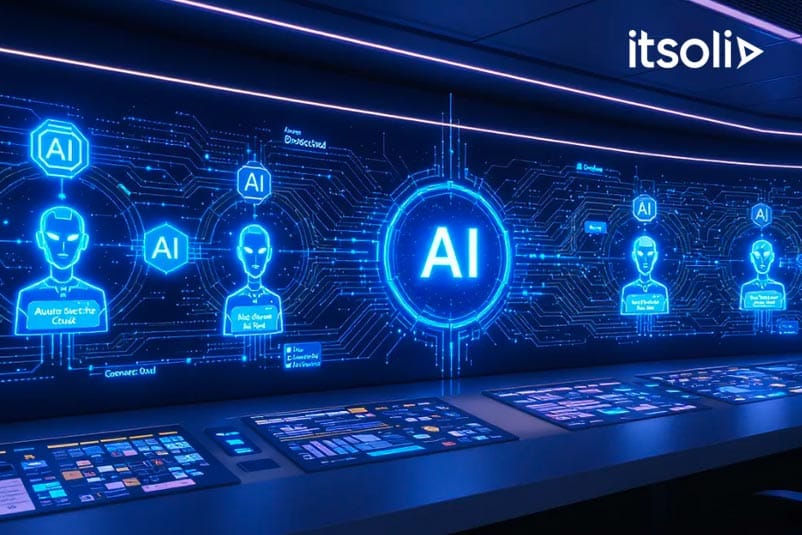
From Single Agents to Agent Orchestration: The Future of Enterprise AI
December 22, 2025
When One Agent Is Not Enough
Your customer service bot handles 60% of inquiries. Your sales assistant qualifies leads. Your HR bot schedules interviews. Each works well — in isolation.
Then a customer asks a question that spans domains: “I want to return this defective product and apply the refund to my next order.”
The customer service bot cannot process orders. The sales bot cannot handle returns. The HR bot is irrelevant. The customer gets bounced between systems — or worse, falls through the cracks.
This is the single-agent ceiling. One bot, one task works — until real-world complexity requires multiple capabilities working together.
The next frontier of enterprise AI is not smarter agents. It is orchestrated agents — systems where multiple specialized agents coordinate to solve complex, multi-step problems.
This article explores why single agents hit limits, how agent orchestration works, and what it takes to deploy multi-agent systems at enterprise scale.
The Limits of Single-Agent AI
Single agents are powerful. But they break down when:
- Tasks Span Multiple Domains
Real business processes rarely live in one domain. A “simple” purchase return involves customer service, inventory, finance, and logistics. One agent cannot master all of these. - Context Requires Multiple Data Sources
A single agent pulling from one database misses the full picture. Understanding a customer requires CRM data, transaction history, support tickets, and product catalog — often in separate systems. - Decisions Require Specialized Expertise
A generalist agent makes mediocre decisions across many tasks. Specialized agents excel at narrow tasks. But you need multiple specialists to cover the full problem space. - Failures Need Graceful Degradation
If your one customer-facing agent fails, the entire AI capability goes dark. A multi-agent system can reroute work when one agent struggles. - Business Logic Is Complex
Real-world workflows have conditional logic, approval chains, and exception handling. Cramming all of that into one agent creates brittle, unmaintainable systems.
Single agents are not going away. But the future belongs to systems where multiple agents work as a team.
What Is Agent Orchestration?
Agent orchestration is the coordination of multiple AI agents to accomplish goals that no single agent can handle alone.
Think of it like a relay race. Each agent runs its leg, then hands off to the next agent. Or like a jazz ensemble — each musician plays their part, and a conductor ensures they stay in sync.
Key components:
- Specialized Agents
Each agent has a focused responsibility:- Customer support agent handles inquiries
- Inventory agent checks stock levels
- Pricing agent calculates discounts
- Payment agent processes transactions
- Routing agent decides which agent handles which request
- Orchestration Layer
A coordinator that:- Routes requests to the right agent
- Manages handoffs between agents
- Resolves conflicts when agents disagree
- Monitors progress and handles failures
- Shared Context
Agents need to share information:- Customer profile
- Conversation history
- Transaction state
- Business rules
- Coordination Protocols
Rules for how agents interact:- Who has authority to make final decisions?
- What happens if two agents conflict?
- How do agents escalate to humans?
Real-World Example: Intelligent Order Management
Imagine a retail company handling a complex customer request:
Customer: “I ordered 3 items. One is damaged. I want to return it, keep the other two, and use the refund credit toward a different product.”
Single-agent approach: One bot tries to handle everything. It gets confused, asks the customer to repeat information multiple times, and eventually escalates to a human.
Multi-agent approach:
- Routing Agent analyzes the request and identifies three sub-tasks: return, refund, new purchase.
- Customer Service Agent verifies the order and damage claim. Approves the return.
- Inventory Agent checks if the replacement product is in stock. Reserves one unit.
- Refund Agent calculates refund amount and applies it as store credit.
- Sales Agent processes the new order using the credit.
- Notification Agent emails the customer with confirmation and tracking.
Each agent did what it does best. The orchestration layer coordinated them. The customer got a seamless experience.
Orchestration Patterns
There are several ways to orchestrate agents. Each has tradeoffs.
Pattern 1: Sequential Orchestration
Agents execute in a fixed order. Agent A completes, then Agent B starts, then Agent C.
When to use: When tasks have clear dependencies (e.g., verify order → process refund → ship replacement).
Pros: Simple to implement and debug.
Cons: Inflexible. Breaks if any agent fails.
Example: A loan application workflow:
- Credit check agent
- Income verification agent
- Risk scoring agent
- Approval agent
Pattern 2: Parallel Orchestration
Multiple agents work simultaneously on independent sub-tasks. Results are aggregated at the end.
When to use: When sub-tasks are independent (e.g., gathering data from multiple sources).
Pros: Fast. Maximizes throughput.
Cons: Requires careful result aggregation.
Example: A competitive intelligence system:
- News scraping agent + Patent search agent + Financial filings agent run in parallel
- Aggregator agent combines insights into a single report
Pattern 3: Conditional Orchestration
Agent B is invoked only if Agent A’s output meets certain conditions.
When to use: When workflows have branches (e.g., if credit score > 700, skip manual review).
Pros: Efficient. Only does work that is necessary.
Cons: Complex logic. Requires robust decision rules.
Example: A claims processing system:
- Claim evaluation agent assesses complexity
- If simple → Auto-approval agent
- If complex → Fraud detection agent → Manual review
Pattern 4: Hierarchical Orchestration
A manager agent delegates to worker agents. Worker agents report back. Manager makes final decisions.
When to use: When tasks require judgment calls that need central coordination.
Pros: Clear authority structure.
Cons: Manager becomes a bottleneck.
Example: A content moderation system:
- Manager agent receives flagged content
- Delegates to text analysis agent, image analysis agent, user history agent
- Aggregates outputs and makes final moderation decision
Pattern 5: Swarm Orchestration
Agents self-organize. No central coordinator. Agents communicate peer-to-peer and converge on solutions.
When to use: When problems are too complex for centralized control (e.g., dynamic resource allocation).
Pros: Resilient. No single point of failure.
Cons: Hard to predict behavior. Can lead to emergent issues.
Example: A logistics optimization system:
- Route planning agents negotiate to minimize total delivery time
- Warehouse agents bid for inventory allocation
- System converges on optimal solution without central planner
Most enterprises start with sequential or parallel orchestration. Swarm orchestration is cutting-edge but risky.
Technology Stack for Agent Orchestration
Building multi-agent systems requires specialized tools.
Agent Frameworks
- LangChain: Python library for building LLM-powered agents. Supports tool use, memory, and chaining.
- LlamaIndex: Focuses on agents that query structured and unstructured data.
- Semantic Kernel: Microsoft’s framework for orchestrating AI agents.
- AutoGen: Research framework from Microsoft for multi-agent conversations.
Orchestration Platforms
- Temporal: Workflow orchestration with built-in retries, timeouts, and state management.
- Airflow: Batch workflow orchestration (adapted for agent workflows).
- Prefect: Modern alternative to Airflow with better support for dynamic workflows.
- Step Functions (AWS): Visual workflow orchestrator with conditional logic.
Communication Protocols
- Message Queues: Kafka, RabbitMQ for asynchronous agent communication.
- REST APIs: Synchronous agent-to-agent calls.
- Event Streams: Agents publish events; other agents subscribe.
Shared State Management
- Redis: In-memory data store for shared context.
- DynamoDB / MongoDB: NoSQL databases for conversation state.
- Feature Stores: For ML-specific shared features.
Example stack:
- Agents built with LangChain
- Orchestrated with Temporal
- Communicate via Kafka
- Share context in Redis
- Monitor with Datadog
Challenges in Agent Orchestration
Multi-agent systems are more complex than single agents. Here are the hard problems:
Challenge 1: Coordination Overhead
Every agent handoff adds latency. Five agents each taking 500ms = 2.5 seconds total. Users expect sub-second responses.
Solutions:
- Run agents in parallel when possible
- Use async communication
- Cache intermediate results
Challenge 2: Conflict Resolution
What if the fraud agent says “block this transaction” but the sales agent says “approve”?
Solutions:
- Define clear priority rules (security > sales)
- Escalate conflicts to humans
- Use voting mechanisms (3+ agents, majority wins)
Challenge 3: State Management
Agents need shared context. But if every agent reads/writes the same state, you get race conditions and consistency issues.
Solutions:
- Use immutable state (agents create new versions, do not mutate)
- Use locking or optimistic concurrency
- Design agents to be stateless when possible
Challenge 4: Failure Handling
If Agent B fails, what happens? Does Agent C still run? Do you retry Agent B? Escalate to a human?
Solutions:
- Implement retries with exponential backoff
- Define fallback agents
- Alert humans after N failures
Challenge 5: Debugging and Observability
When a multi-agent workflow fails, tracing the root cause is hard. Which agent caused the issue? What state was it in?
Solutions:
- Log every agent invocation with trace IDs
- Visualize workflows in real-time
- Implement distributed tracing (Jaeger, Zipkin)
Challenge 6: Cost Control
Every agent call costs money (API calls, compute, tokens). A workflow with 10 agents can get expensive fast.
Solutions:
- Cache agent outputs aggressively
- Use cheaper models for low-stakes agents
- Set cost budgets per workflow
Governance in Multi-Agent Systems
With great power comes great responsibility. Multi-agent systems need governance.
Who Owns the Workflow?
Each workflow should have a clear owner responsible for:
- Defining agent roles
- Setting escalation rules
- Monitoring performance
- Handling failures
How Do You Audit Decisions?
Every agent decision should be logged:
- Which agent made the decision?
- What inputs did it use?
- What was the confidence score?
- Was it overridden by a human?
This is critical for compliance, especially in regulated industries.
How Do You Control Agent Behavior?
Agents can go rogue (hallucinate, violate policies, spend too much money). Implement guardrails:
- Max tokens per agent call
- Output validation (reject harmful content)
- Human-in-the-loop for high-risk decisions
Building Your First Multi-Agent System
Start simple. Do not try to build a 50-agent system on day one.
Step 1: Identify a Multi-Step Workflow
Pick a business process that currently requires multiple people or systems.
Examples:
- Customer onboarding (verify identity → open account → send welcome kit)
- Expense approval (submit receipt → verify policy → check budget → approve)
- Incident response (detect issue → diagnose → escalate → resolve)
Step 2: Define Agent Roles
Break the workflow into clear sub-tasks. Each sub-task becomes an agent.
Example for expense approval:
- Receipt parsing agent
- Policy compliance agent
- Budget checking agent
- Approval routing agent
Step 3: Design the Orchestration
Decide how agents coordinate:
- Sequential or parallel?
- Who makes final decisions?
- What happens if an agent fails?
Draw the workflow as a flowchart. This becomes your orchestration logic.
Step 4: Build and Test Agents Independently
Build each agent as a standalone service. Test it in isolation. Make sure it works reliably before integrating.
Step 5: Implement Orchestration
Use a workflow engine (Temporal, Airflow) to coordinate agents. Start with a simple happy path. Add error handling and edge cases iteratively.
Step 6: Deploy and Monitor
Deploy to production with monitoring. Track:
- End-to-end latency
- Success rate per agent
- Escalation rate to humans
- Cost per workflow execution
Step 7: Iterate
Multi-agent systems improve over time. Add agents, refine coordination logic, optimize for latency and cost.
Real-World Examples
Healthcare: Patient Triage System
A hospital deployed a multi-agent triage system:
- Symptom checker agent interviews patients
- Risk scoring agent assesses urgency
- Scheduling agent books with appropriate specialist
- Insurance agent verifies coverage
Result: Wait times reduced by 40%. Patient satisfaction increased.
Finance: Loan Underwriting
A bank built a multi-agent underwriting system:
- Document extraction agent parses loan applications
- Credit check agent pulls credit reports
- Income verification agent validates employment
- Risk model agent scores default probability
- Approval agent makes final decision
Result: Loan approval time dropped from 5 days to 2 hours.
Retail: Dynamic Pricing
An e-commerce company uses agent orchestration for pricing:
- Competitor monitoring agent tracks rival prices
- Demand forecasting agent predicts sales volume
- Inventory agent checks stock levels
- Pricing optimization agent calculates optimal price
- Approval agent applies guardrails (no predatory pricing)
Result: Revenue per product increased by 12%.
The Future: Agents All the Way Down
Single agents were the first wave. Multi-agent orchestration is the second wave.
The third wave? Recursive orchestration — agents that orchestrate other agents, dynamically creating subagents as needed.
Imagine an executive assistant agent that:
- Analyzes your request
- Spawns specialized sub-agents (research, scheduling, drafting)
- Coordinates their work
- Aggregates results
- Presents final output
This is not science fiction. Frameworks like AutoGen and LangGraph are building this today.
From Bots to Teams
The age of single-purpose chatbots is ending. The age of coordinated AI teams is beginning.
Organizations that master agent orchestration will not just automate tasks. They will reimagine entire workflows — making them faster, smarter, and more adaptive.
The future of enterprise AI is not one super-agent. It is many specialized agents, orchestrated brilliantly.
Build your first multi-agent system. Learn what works. Scale what succeeds.
That is how you move from AI experiments to AI systems that transform operations.

© 2026 ITSoli

