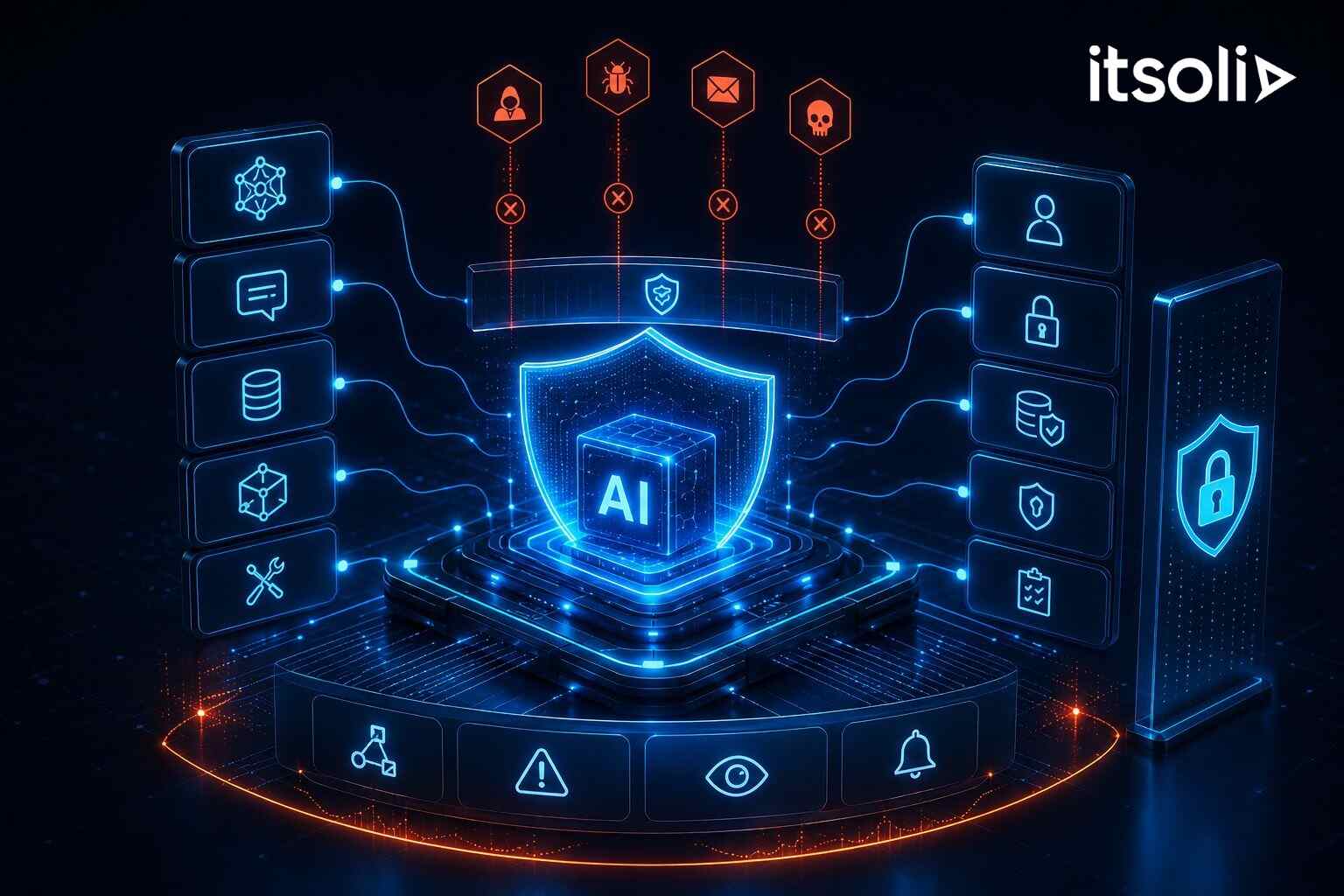
Enterprise AI Security: Protecting Knowledge, Models, and Decision Systems
September 1, 2026
Traditional security focused on networks, applications, identities, and data.
AI adds new assets:
- Models
- Prompts
- Embeddings
- Knowledge bases
- Agent tools
- Training data
- Decision logs
- Evaluation datasets
These assets can be manipulated, stolen, exposed, or misused.
AI security therefore requires more than applying existing controls to new tools.
It requires a broader security model.
Data Leakage Through AI Tools
One of the most immediate risks is sensitive data leakage.
Employees may paste:
- Client information
- Source code
- Contracts
- Financial data
- Internal strategy
- Personal information
into public AI tools.
Even when providers offer privacy protections, enterprises need clear policies and controls.
Security teams should define:
- Approved tools
- Approved data classes
- Retention rules
- Logging requirements
- User access
- Prohibited inputs
Training is essential.
Many users do not recognize that a prompt can contain sensitive data.
Prompt Injection
Prompt injection occurs when malicious input attempts to override system instructions.
This risk becomes serious when AI systems connect to tools or data.
An attacker may try to make an agent:
- Reveal restricted information
- Ignore policy
- Execute unauthorized actions
- Access hidden prompts
- Modify records
- Send data externally
Prompt injection cannot be solved through prompt wording alone.
Security requires:
- Input filtering
- Tool permissioning
- Output validation
- Least-privilege access
- Human approval for high-risk actions
- Continuous testing
Model Supply Chain Risk
Enterprises increasingly rely on external models, open-source components, and third-party tools.
This creates supply chain risk.
Questions include:
- Where did the model come from?
- How was it trained?
- Has it been modified?
- What vulnerabilities exist?
- What dependencies does it use?
- Can the provider change behavior without notice?
Model provenance and version control are essential.
Organizations should maintain an inventory of models and dependencies.
Knowledge Base Security
Enterprise AI often connects to internal knowledge.
If access control is weak, users may retrieve information they should not see.
For example, an employee may ask an AI assistant about confidential HR records, executive strategy, or restricted client data.
Permission controls must apply at retrieval time.
The system should respect:
- Role
- Department
- Geography
- Data classification
- Document-level access
A secure knowledge system should never rely on the model to decide access.
Agent Security
AI agents can take action.
That increases risk.
An agent may:
- Send email
- Update CRM records
- Approve requests
- Trigger payments
- Create accounts
- Call external APIs
Each tool should have limited permissions.
High-risk actions should require approval.
Actions should be logged and reversible where possible.
An agent should never receive broad access simply because it is convenient.
Model Theft and Intellectual Property
Custom models, fine-tuning data, prompt libraries, and evaluation datasets may represent valuable intellectual property.
They can reveal:
- Business logic
- Customer patterns
- Internal policy
- Strategic methods
- Proprietary workflows
Security controls should protect these assets through:
- Encryption
- Access management
- Environment isolation
- Audit logging
- Vendor contracts
- Export restrictions
Monitoring AI Behavior
Traditional security monitoring looks for known patterns.
AI behavior may fail in unexpected ways.
Monitoring should include:
- Unusual prompt activity
- Large data extraction
- Repeated jailbreak attempts
- Unauthorized tool calls
- Output containing sensitive content
- Sudden cost spikes
- Changes in response patterns
AI observability and security monitoring should work together.
Red Teaming
AI systems should be tested adversarially.
Red teams can explore:
- Prompt injection
- Data leakage
- Bias
- Unsafe actions
- Access control failures
- Hallucination under pressure
- Tool misuse
Testing should happen before launch and continue after deployment.
New threats will emerge as user behavior changes.
Governance and Incident Response
AI security incidents require clear response plans.
The enterprise should know:
- Who can pause the system
- How logs are preserved
- How affected users are notified
- How model versions are rolled back
- How prompts or policies are updated
- How root causes are investigated
AI should be part of the enterprise incident response framework.
Security as an Enabler
Strong security does not slow AI adoption.
It makes safe scaling possible.
When employees have approved tools, clear policies, secure knowledge access, and trusted workflows, they can use AI with confidence.
The goal is not to eliminate risk.
The goal is to control it.
Enterprise AI security protects more than technology.
It protects knowledge, decisions, customers, and trust.
Service alignment: Custom AI Models & Agents | Strategic Partnerships

© 2026 ITSoli

