How AI Changes the Economics of Enterprise Service Operations
November 10, 2026
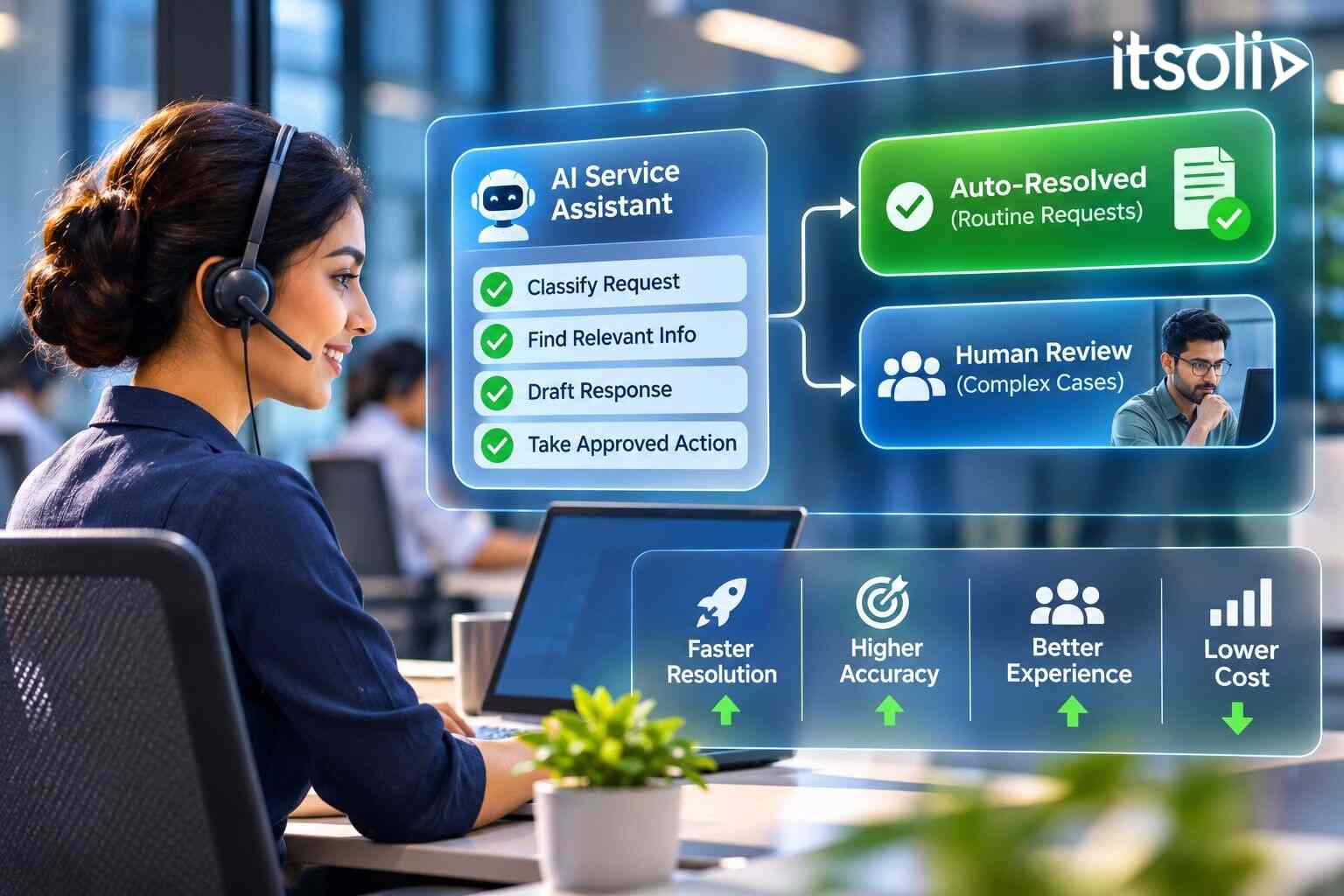
Service operations are built around queues, specialised teams, service levels, and the effort required to handle each request. AI changes this model by assisting with classification, summarisation, knowledge retrieval, drafting, and selected actions. But the impact is not simply fewer minutes per ticket. Automation changes the mix of work reaching people. Straightforward requests may be resolved quickly while more complex cases remain. That shift can change training needs, staffing patterns, escalation processes, and the true cost of delivering reliable service.
Analyse Work at Task Level
Before estimating savings, break each service journey into individual tasks. A customer issue may require identification, information gathering, interpretation, policy checking, system updates, and communication. Some tasks can be automated safely; others need human judgment or authority. Measure volumes, handling times, variation, and error rates for each step. This detailed view prevents teams from treating an entire process as a single automation candidate. It also reveals integration and knowledge gaps that may be more important than the choice of language model.
Expect the Case Mix to Change
When low-complexity cases are automated, the average complexity of the remaining human queue often increases. Historical productivity targets may become misleading because agents now handle more exceptions and emotionally sensitive situations. Workforce planning should consider case complexity and resolution quality, not only ticket counts. Organisations may need stronger specialists, better decision support, and redesigned escalation pathways. The value of AI is partly in freeing human attention for work that benefits from expertise, but those gains require deliberate operational planning.
Measure End-to-End Service Outcomes
A bot may resolve the first interaction quickly while creating repeat contact later. Evaluate first-contact resolution, customer effort, correct completion, reopens, complaint escalation, and time to final outcome. Include the full cost of automated and human touchpoints. Poorly designed automation can shift work to customers or downstream teams without reducing it. Quality measures should therefore accompany efficiency measures. For important processes, periodically review samples of conversations and transactions to assess whether outcomes match the apparent dashboard success.
Redesign the Operating Model
An effective service model establishes who owns the AI-assisted workflow, who maintains its knowledge, and who responds to failures. Frontline teams need clear mechanisms to challenge incorrect suggestions and correct outdated sources. Supervisors should review patterns in unresolved cases rather than simply checking throughput. Technology teams must maintain integrations and controls; business teams must own policy and experience. Training should explain when to trust automation, when to verify it, and how to escalate. Without these changes, organisations often layer AI onto an operating model that was never designed to support it.
Scale Through Measured Improvements
A prudent rollout begins with a narrow service segment and records both costs and outcomes before expansion. Introduce more complex requests only after evaluating exception rates and the burden transferred to human teams. Regularly compare predicted savings with actual capacity and experience changes. An initiative that improves response time but reduces accuracy may require redesign. Conversely, a capability that saves little time but improves consistency may still justify investment. Understanding these trade-offs allows enterprise service leaders to pursue better operations rather than automation for its own sake.
A Service Operations Pilot That Tells the Truth
Choose one service category with stable volumes and clear outcomes. Document the present customer journey, including repeat contact and escalations, before adding AI support. During the pilot, measure not just automated resolutions but the workload and complexity arriving in human queues. Invite frontline employees to classify unhelpful suggestions and missing knowledge. Review changes to customer satisfaction alongside unit cost. This gives leaders evidence to decide whether to expand automation, improve the knowledge base, or redesign the handoff.
Operational leaders should also examine demand effects. Faster, more accessible service can increase contact volume because customers ask questions they previously abandoned or employees submit requests that were previously too inconvenient. Higher usage is not necessarily a failure, but it changes the economics. Forecasting should account for demand growth rather than assuming that automation reduces workload proportionally. Understanding the interaction between lower unit effort and greater service utilisation is essential for realistic capacity plans. Another source of value is consistency across channels.
An AI-assisted service process should apply the same approved policy whether a request arrives by email, chat, or an internal portal. Inconsistent answers create repeat contacts and expensive corrections. Shared knowledge and decision controls can reduce this variation, but only when channel-specific integrations are maintained and tested. Service transformation succeeds when the operating model treats customer experience, policy enforcement, and automation as one connected system.
For implementation teams, the most important next step is to choose one measurable workflow, document its decision points, and establish clear ownership of both technical and business outcomes. Review actual user cases at a regular cadence, including successful outcomes and difficult exceptions. Translate findings into changes to source data, policy, interface design, and test coverage rather than relying on prompt adjustments alone. This operating rhythm keeps improvement tied to evidence and prevents a promising prototype from becoming an unmanaged dependency.
What Leaders Should Take Forward
The strongest service transformations improve the complete experience, not only the speed of the automated step. AI becomes economically useful when its effects on customers, specialists, workflow quality, and operating capacity are measured together.
Service alignment: AI Adoption & Transformation | Custom AI Models & Agents

© 2026 ITSoli

